
“The Cambridge English position In the Cambridge English Teaching Framework and in the Celta/Delta syllabuses we refer to ‘learning styles’ as a concept which teachers should be aware of, alongside other concepts. We believe that a prescriptive one-style-per-student concept is reductive and limiting. This is reflected in our materials and qualifications, which recommend that teachers use a variety of teaching methods, rather than link specific learning methods to specific learning styles.

We are currently updating our documentation and the term ‘learning preferences’ will be used to capture the fact that this concept is not a simple binary dichotomy or a finite set of styles. We see learning preferences as a core idea within online, adaptive, personalised learning and differentiated teaching. Different learning materials and teaching approaches add value to learners in different ways and the most effective and efficient learning is achieved through a varied teaching ‘toolbox’ which personalises teaching to individual needs and preferences, without being reductive. In fact, there is emerging evidence that an online learning environment is conducive to supporting a variety of learning preferences, and technology – when used appropriately to add value – can expand the toolbox of the teacher.
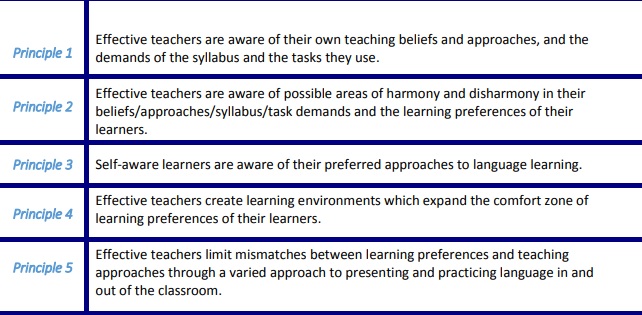
These general principles are aimed at helping to raise awareness of differences in learning styles and the importance for teachers and learners to be sensitive to potential mismatches between teaching/learning styles. In practical terms, these principles mean that teachers need a varied and evolving teaching toolbox. For example, the teaching of a grammar point in a language classroom can be structured around presenting the information deductively or inductively, concretely or in a more abstract manner, holistically or more analytically, emphasising communication or formal aspects of grammar, embedding it in a listening exercise, a reading passage, a fluency or accuracy speaking task, an open-ended ‘real-life’ task, etc.”
Source: Cambridge English Assessment
 Cambridge English Languages
You must be logged in to post a comment.