Congratulations to everyone at Mosaiksekundarschule Alterswilen for their excellent results for B1 Preliminary and B2 First!

Congratulations to everyone at Mosaiksekundarschule Alterswilen for their excellent results for B1 Preliminary and B2 First!
Thank you for attending our seminar about the the updates for A2 and B1 in 2020.
If you couldn’t attend the seminar, and would like to find out what happened, join the webinar so you can catch up.
We are very proud to announce Computer Delivered IELTS in Bern from 20th June 2019.
We will be running Computer Delivered IELTS in Bern at least once every week from 20th June to add to our Computer Delivered IELTS sessions in St. Gallen. Click here to see our test dates for Switzerland.
Computer Delivered IELTS is now available every week in St. Gallen. To see our test dates and fees, click here.
Results available in 5 – 7 days.
We are delighted to invite you to our free seminar on the revised formats of A2 Key and B1 Preliminary. The seminars will be divided into two sessions, session 1 will focus on A2 Key, while session 2 will cover B1 Preliminary.
In both sessions, we will first introduce the new formats A2 Key and B1 Preliminary, highlighting the changes coming into effect as of January 2020 and explaining the rationale behind these changes. In addition, we will provide information about updated and new resources and reference materials.
In the second part of the two sessions, we will present preparation tips and strategies for exam success as well as teaching activities to use with your learners.
Seminar in St. Gallen
Date: Thursday, 23 May 2019
Time: 13.30-14.00 Registration
14.00-15.15 Session 1: Preparing for A2 Key 2020
15.15-15.30 Break
15.30-16.45 Session 2: Preparing for B1 Preliminary 2020
Venue: KS Kaderschule, Oberer Graben 26, 9000 St. Gallen.
Registration: https://www.cambridgetesting.ch/event-registration
Youngs Learners Starters, Young Learners Movers, Young Learners Flyers, Key for Schools and Preliminary for Schools
Congratulations to all the children and teachers at Öberstufenzentrum Wier!



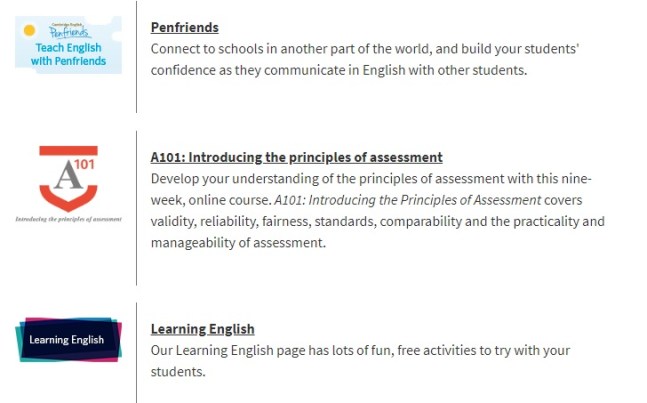
Refresh your lesson planning or develop your teaching practice with these Cambridge English resources. Get free materials such as lesson plans, sample exam papers, handbooks and teacher guides.
How to search for free resources?
3. Results

“The Cambridge English position In the Cambridge English Teaching Framework and in the Celta/Delta syllabuses we refer to ‘learning styles’ as a concept which teachers should be aware of, alongside other concepts. We believe that a prescriptive one-style-per-student concept is reductive and limiting. This is reflected in our materials and qualifications, which recommend that teachers use a variety of teaching methods, rather than link specific learning methods to specific learning styles.

We are currently updating our documentation and the term ‘learning preferences’ will be used to capture the fact that this concept is not a simple binary dichotomy or a finite set of styles. We see learning preferences as a core idea within online, adaptive, personalised learning and differentiated teaching. Different learning materials and teaching approaches add value to learners in different ways and the most effective and efficient learning is achieved through a varied teaching ‘toolbox’ which personalises teaching to individual needs and preferences, without being reductive. In fact, there is emerging evidence that an online learning environment is conducive to supporting a variety of learning preferences, and technology – when used appropriately to add value – can expand the toolbox of the teacher.
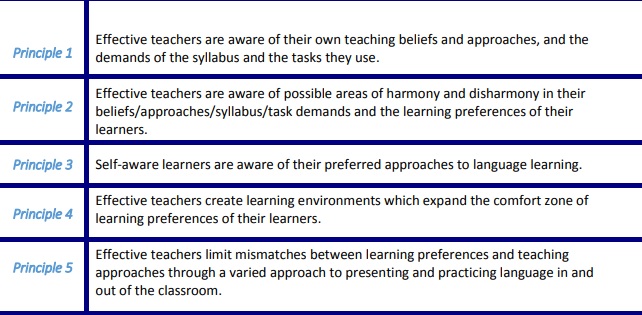
These general principles are aimed at helping to raise awareness of differences in learning styles and the importance for teachers and learners to be sensitive to potential mismatches between teaching/learning styles. In practical terms, these principles mean that teachers need a varied and evolving teaching toolbox. For example, the teaching of a grammar point in a language classroom can be structured around presenting the information deductively or inductively, concretely or in a more abstract manner, holistically or more analytically, emphasising communication or formal aspects of grammar, embedding it in a listening exercise, a reading passage, a fluency or accuracy speaking task, an open-ended ‘real-life’ task, etc.”
Source: Cambridge English Assessment

#1: Globally recognised by more than 20,000 leading universities, employers and governments, these research-based assessments are a mark of excellence that open doors.
#2: Cambridge Assessment English delivers qualifications and tests in over 130 countries to over 5.5 million people every year.
#3: Their work is supported around the world by a network of 2,800 exam centres, over 50,000 schools and tens of thousands of examiners, teachers, education experts and publishers.
#4: Established over 150 years ago, Cambridge Assessment owns and manages the
University’s three exam boards and carries out leading-edge academic and operational
research on assessment in education. We are a not-for-profit organisation
#5: Assessment and test design: In addition to our range of tests we offer customised assessment services that deliver all the benefits of Cambridge certification. Tests can be integrated into existing regional or national frameworks.
#6: Teacher and trainer development: We work with governments to reform education systems and help localise examinations by training officials, teachers, markers and examiners. Our training and support services are extensive.
#7: Delivering assessment excellence in other industries: We have forged strong links with IT industry partners, such as Cisco, Microsoft and Comptia, to develop a range of IT
qualifications. We have also worked with companies such as IBM to ensure that their internal training programmes allow staff to achieve an IT Apprenticeship.
#8: We provide consultancy and benchmarking for governments worldwide. For example, we hosted events to discuss the wider context of language assessment with policy makers and academics.
#9: Since 1982 we have helped to shape and establish Singapore’s education system. Throughout a number of reforms, Singapore’s ‘Cambridge Connection’ – built on mutual trust and understanding – continues to contribute to an educational system that is recognised for high-quality outcomes around the world.
#10: Our research on Emotional Intelligence and its impact on improving attainment
was put under the spotlight in roundtables at the UK political Party Conferences, stimulating lively discussion.
Source: http://www.cambridgeassessment.org.uk
 Cambridge English Languages
You must be logged in to post a comment.