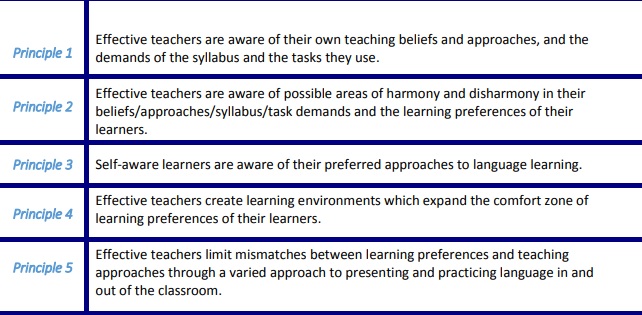
“The Cambridge English position In the Cambridge English Teaching Frameworkand in the Celta/Delta syllabuses we refer to ‘learning styles’ as a concept which teachers should be aware of, alongside other concepts. We believe that a prescriptive one-style-per-student concept is reductive and limiting. This is reflected in our materials and qualifications, which recommend that teachers use a variety of teaching methods, rather than link specific learning methods to specific learning styles.
We are currently updating our documentation and the term ‘learning preferences’ will be used to capture the fact that this concept is not a simple binary dichotomy or a finite set of styles. We see learning preferences as a core idea within online, adaptive, personalised learning and differentiated teaching. Different learning materials and teaching approaches add value to learners in different ways and the most effective and efficient learning is achieved through a varied teaching ‘toolbox’ which personalises teaching to individual needs and preferences, without being reductive. In fact, there is emerging evidence that an online learning environment is conducive to supporting a variety of learning preferences, and technology – when used appropriately to add value – can expand the toolbox of the teacher.
These general principles are aimed at helping to raise awareness of differences in learning styles and the importance for teachers and learners to be sensitive to potential mismatches between teaching/learning styles. In practical terms, these principles mean that teachers need a varied and evolving teaching toolbox. For example, the teaching of a grammar point in a language classroom can be structured around presenting the information deductively or inductively, concretely or in a more abstract manner, holistically or more analytically, emphasising communication or formal aspects of grammar, embedding it in a listening exercise, a reading passage, a fluency or accuracy speaking task, an open-ended ‘real-life’ task, etc.”
#1: Globally recognised by more than 20,000 leading universities, employers and governments, these research-based assessments are a mark of excellence that open doors.
#2: Cambridge Assessment English delivers qualifications and tests in over 130 countries to over 5.5 million people every year.
#3: Their work is supported around the world by a network of 2,800 exam centres, over 50,000 schools and tens of thousands of examiners, teachers, education experts and publishers.
#4: Established over 150 years ago, Cambridge Assessment owns and manages the
University’s three exam boards and carries out leading-edge academic and operational
research on assessment in education. We are a not-for-profit organisation
#5: Assessment and test design: In addition to our range of tests we offer customised assessment services that deliver all the benefits of Cambridge certification. Tests can be integrated into existing regional or national frameworks.
#6: Teacher and trainer development: We work with governments to reform education systems and help localise examinations by training officials, teachers, markers and examiners. Our training and support services are extensive.
#7: Delivering assessment excellence in other industries: We have forged strong links with IT industry partners, such as Cisco, Microsoft and Comptia, to develop a range of IT
qualifications. We have also worked with companies such as IBM to ensure that their internal training programmes allow staff to achieve an IT Apprenticeship.
#8: We provide consultancy and benchmarking for governments worldwide. For example, we hosted events to discuss the wider context of language assessment with policy makers and academics.
#9: Since 1982 we have helped to shape and establish Singapore’s education system. Throughout a number of reforms, Singapore’s ‘Cambridge Connection’ – built on mutual trust and understanding – continues to contribute to an educational system that is recognised for high-quality outcomes around the world.
#10: Our research on Emotional Intelligence and its impact on improving attainment
was put under the spotlight in roundtables at the UK political Party Conferences, stimulating lively discussion.
Contrary to some opinions you might have heard, lots of teacher talk in English is actually a good thing. It’s an excellent source of English language comprehensible input.
It’s likely to be better than recorded or filmed input, because it’s directly addressed to your students, you can design and adapt it to suit their levels and needs, and it’s ‘live’, taking place in real time.
Your spoken input is particularly important if your students hear little or no English outside your classroom – which is true for most teaching situations in the world today. In such cases, you are the only source of good spoken English your students will have.
Teacher talk can take the form of explicit language teaching: explanations of grammar or vocabulary, for example. Or it can be instructions on how to do an activity or what the homework is.
So don’t feel guilty that you’re talking too much, or that your classroom is too teacher-centred!
Tip #2: Use mother tongue occasionally
In most English teaching situations, students share a mother tongue (L1) which is known also to the teacher.
If we insist on speaking exclusively in English when students are not understanding, we are conveying the messages that English is incomprehensible, or that it’s OK not to understand – messages which surely we don’t want our students to get. And a lot of students get frustrated and demoralised by their lack of comprehension: it makes them feel stupid.
A more positive argument is that the fact that students already know one language can be used to help learning. Occasional use of the L1 in our own speech can add clarity, provide useful insights into how the language works, and save time which can then be used for further engagement with English. So use L1 in, for example, the following situations:
If there’s an explanation of grammar or vocabulary which would be too difficult for the students in English, explain quickly in the L1 and then use the time saved to provide, or elicit from students, examples of the target items in use.
If students are commonly making a mistake based on L1 interference, show them what the difference is between the two languages that produces the mistake: it will help them avoid it.
If students can understand most of the content of what you are talking about – for example, when you’re telling a story – allow yourself to translate an unknown word here and there, to help students follow.
Tip #3: Don’t give homework at the end
If you know you have a homework assignment to give, explain it sometime in the middle of the lesson and make sure students have noted it down. Don’t leave it until the last minute.
In general, give the homework immediately after the lesson component that it relates to: for example, comprehension work on a text you’ve been reading. Then you aren’t rushed, can explain fully and answer questions about it, and students have time to write it down. If you note it at the side of the board as you explain, then you can use this note as the basis for a brief reminder before closing the lesson later.
Tip #4: Prepare homework-giving in advance
It’s not enough just to note down in advance what homework you are going to assign; you need to think about how you’re going to give it, and at what point in the lesson.
You need to plan, and allow several minutes of lesson time, for the following:
Giving clear instructions. It may be necessary, in beginner classes, to give these in the students’ mother tongue, if you know it, in order to be quite certain that they understand. Another useful strategy is to perform a sample of the ‘kind of thing’ you are asking them to do with volunteer students, in order to clarify. For example, do one or two of the items of the exercise, or write a elicit a sentence or two of a written assignment.
Writing up the homework on the board as well as just giving oral instructions. Doing this makes the assignment clearer, and also enables you to come back at the end of the lesson and remind students about it, pointing to the note on the board.
Giving students the opportunity to ask questions, in order to clarify anything that isn’t clear to them.
Telling them why you are giving it. It’s important for students to be aware what the learning purpose is: that it’s not just given arbitrarily for the sake of giving homework!
Getting students to write down the assignment in their notebooks, including the date when it is due.
Optionally, giving them time to start doing it in class.
For more tips, please watch:
Penny Ur’s new book 100 Teaching Tips, the latest in our Cambridge Handbook for Language Teachers series. We’re sharing with you four tips of the book’s 100 hands-on tips across 19 different areas of classroom teaching, based on Penny’s comprehensive teaching experience in ELT over the past 40 years.
Who is Penny Ur?
Penny was educated at the universities of Oxford (MA), Cambridge (PGCE) and Reading (MA). She emigrated to Israel in 1967, where she still lives today. Penny has thirty years’ experience as an English teacher in elementary, middle and high schools in Israel. Now retired, she has taught M.A. courses at Oranim Academic College of Education and Haifa University.
Penny has presented papers at TESOL, IATEFL and various other English teachers’ conferences worldwide. She has published a number of articles, and was for ten years the editor of the Cambridge Handbooks for Language Teachers series.
Her books include Discussions that Work (1981), Five Minute Activities (co authored with Andrew Wright) (1992), A Course in Language Teaching (1996), and Grammar Practice Activities (2nd Edition) (2009), all published by Cambridge University Press.
SVEB 1 enables you to teach adult learners within the Swiss context and is required by most schools all over Switzerland. SVEB 1 can be acquired by taking a 150-hour SVEB 1 course in German or via CELTA and the From CELTA to SVEB1 Bridge Course.
Teachers of English must have the CELTA (Certificate as an English Language Teacher to Adults) or an equivalent first and then do the 2-day add-on From CELTA to SVEB1 Bridge Course, which is offered here at the centre.
What is involved in the SVEB 1 Bridge Course?
There are 3 components to the From CELTA to SVEB1 Bridge Course:
1. An online course task. This requires you to post answers onto a forum while reading Hadfield’s book “classroom dynamics”. It will be set during day one of the course.
2. The course itself, which is a 2-day course on classroom dynamics, conflict management and most importantly “the Swiss educational system”.
3. A post-course task (reflective essay).
What might a course timetable look like?
week 1: face-to-face course, 1 full day
week 2: online (this includes reading Hadfield’s book “Classroom Dynamics” and posting and replying to comments on a forum)
week 3: online (this includes reading Hadfield’s book “Classroom Dynamics” and posting and replying to comments on a forum)
week 4: online (this includes reading Hadfield’s book “Classroom Dynamics” and posting and replying to comments on a forum)
week 5: face-to-face course, 1 full day
weeks 6 and 7: post-course task
What happens after successful completion of the course?
After successful completion of course components 1-3 of the CELTA to SVEB1 Bridge Course, you will get a statement of attendance by the centre. As soon as you hand in proof of having taught 150 – to adults – hours within a 2-year period (which can be done prior to the course), you will receive the official certificate that enables you to teach adult learners within the Swiss context.
How much is the SVEB 1 Bridge Course?
The SVEB I Bridge Course costs CHF 680.00.
Additionally, you will need Hadfield’s book ‘Classroom Dynamics’ copies of which are available from us at a cost of CHF 54.00. To order a copy please send an email to: dweeks@cambridgeenglish-stgallen.ch
*Start Date course: Friday, 17 August 2018 to Friday, 21 September 2018.
IELTS Morgan Terry Memorial IATEFL Scholarship 2019
This scholarship is in memory of Morgan Terry, a dear colleague who made a significant contribution to the work of IELTS until her untimely death in 2011.
The award consists of:
registration for the TEA SIG’s pre‑IATEFL conference event
registration for IATEFL
a year’s IATEFL membership
a maximum of five nights’ accommodation
travel costs including, if necessary, an economy flight to the UK* GBP 55.00 per day expenses.
* This includes cost of flights and airport transfers but not the costs of stopovers.
To qualify you must:
have prepared learners for taking IELTS
have never attended the main IATEFL annual conference
agree to write an article 6 months after the conference about how attendance at the conference has enriched your practice.
To be considered you should submit:
a 400–500-word description of educational material you have created (e.g. lesson plan, classroom activity) and used to prepare prospective IELTS candidates for taking the test. The description should include:
the creation process behind the material
the reason(s) why the material is innovative
how the material may be used by other teachers
the IATEFL format CV (maximum two sides of A4)
a passport-size photograph (for inclusion in the conference programme if you win).
Watch the below video to know more about IATEFL Scholarship, its benefits and the application process:
The submission deadline is Tuesday 18 July 2018.
Please apply using IATEFL’s online application form and CV format. Make sure you have your photo ready to upload. The winner will be informed by the beginning of September 2017.
Please note applications will be accepted, via IATEFL’s website, from the middle of April 2017.
Karen, Director of CEL-Cambridge English Languages, Sharon Toms-Smith Head EAL & Academic Support, International Section, Institut auf dem Rosenberg and Matt Willians, Head, International Section, Institut auf dem Rosenberg, presented 4 of the 6 participants on Friday with their CELTA certificates. Congratulations to all 6 of you for passing with excellent marks!
See www.celta.ch for information on Teacher Training Awards!
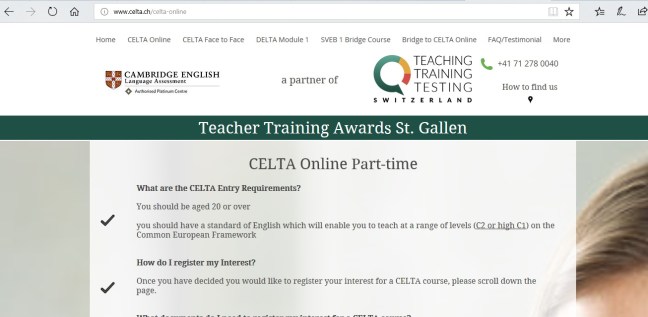
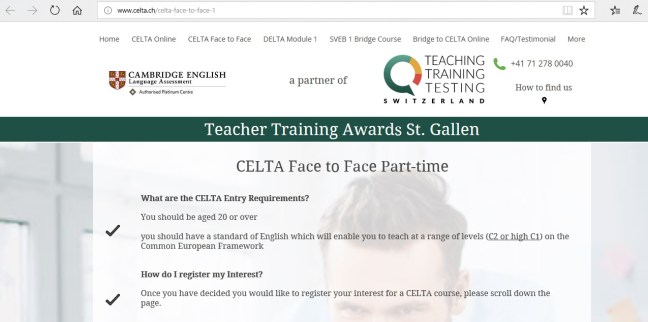
Register your interest now in Celta Online or Celta Face to Face. Look at Bridge to Celta for a 3 week online course investing 5 hours a week to prepare for Celta Teacher Training Award.
Educational institutions, employers, professional registration bodies and government immigration agencies often require proof of Englishlanguage skills as part of their recruitment or admission procedures. IELTS is widely accepted for these purposes.
IELTS test is available at more than 1,200 locationsworldwide.
Data is routinely collected from live tests and analysed to confirm the accuracy of the initial grading process and to support on-going quality assurance processes.
Test writers from different English-speaking countriesdevelop IELTS content so it reflects real-lifesituations around the world and is unbiased and fair to all test takers, whatever their background.
Length of the test: About 2 hours 45 minutes but may last up to 3 hours and 15 minutes. *Remember: you need 30 minutes for the speaking test and administration.
IELTS is accepted for migration to Australia, Canada, New Zealand and the United Kingdom.
IELTS is accepted as evidence of English proficiency by 10,000 institutions of education worldwide.
Many professional registration bodies and employersrely on IELTS as evidence of English language proficiency. Examples are the healthcare professions, such as nursing, medicine and pharmacy, where English language competence is of critical importance.
Test security: training of test centre staff to help them identify imposters, detect fraudulent behaviourand prevent cheating to ensures the high standard of the IELTS test.










 Cambridge English Languages
You must be logged in to post a comment.